When beginners enter the stock market, they often hear two terms repeatedly: trading and investing. Many assume these terms mean the same thing, but in reality, they represent two completely different approaches.
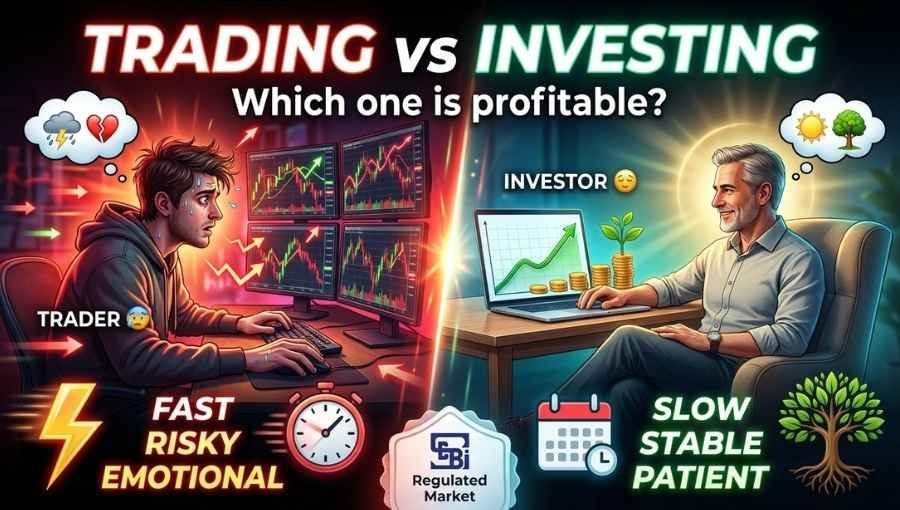
Trading vs Investing
Trading focuses on short-term price movements, while investing focuses on long-term business growth. Understanding this difference is important because it affects your risk level, time commitment, and overall strategy.
What Is Trading?
Trading involves buying and selling stocks frequently to take advantage of short-term price movements.
Traders aim to profit from small price changes that occur within short timeframes such as:
- Minutes
- Hours
- Days
- Weeks
Instead of focusing on company fundamentals, traders primarily analyze:
- Price trends
- Market patterns
- Technical indicators
Trading requires:
- Continuous market monitoring
- Quick decision-making
- Strong emotional control
Trading is about timing the market rather than holding ownership for long periods.
What Is Investing?
Investing focuses on buying shares of companies and holding them for a longer duration.
Investors believe that strong businesses grow over time, and their stock prices reflect that growth.
They focus on:
- Company fundamentals
- Long-term profitability
- Industry growth
For example, investing in a company like Reliance Industries means participating in its long-term growth.
Investing benefits from compounding and long-term economic expansion.
Trading vs Investing: Key Differences
| Factor | Trading | Investing |
|---|---|---|
| Time Horizon | Short-term | Long-term |
| Focus | Price movements | Business growth |
| Analysis | Technical analysis | Fundamental analysis |
| Risk Level | Higher | Relatively lower |
| Time Commitment | Very high | Moderate |
Trading is fast-paced and requires active involvement, while investing is patient and growth-oriented.
Time Horizon
One of the biggest differences between trading and investing is the duration of holding.
| Approach | Typical Holding Period |
|---|---|
| Trading | Minutes to weeks |
| Investing | Years |
The longer the investment horizon, the more time your capital has to grow.
Risk Level
Trading generally involves higher risk because it depends on short-term price fluctuations.
| Approach | Risk Level | Reason |
|---|---|---|
| Trading | High | Depends on short-term price movements |
| Investing | Moderate | Based on long-term business growth |
Short-term market movements are difficult to predict, which increases uncertainty in trading.
Effort and Time Required
Trading requires constant attention and monitoring of price movements.
Investing, on the other hand, involves:
- Studying company performance
- Understanding business models
- Periodic portfolio review
| Factor | Trading | Investing |
|---|---|---|
| Monitoring | Continuous | Periodic |
| Effort | High | Moderate |
| Decision Speed | Fast | Thoughtful |
Investing allows a more structured and less stressful approach.
Costs and Transaction Frequency
Frequent trading leads to higher costs, including:
- Brokerage charges
- Taxes
- Transaction fees
| Approach | Transaction Frequency | Cost Impact |
|---|---|---|
| Trading | High | Higher costs |
| Investing | Low | Lower costs |
Lower transaction frequency helps investors retain more of their returns over time.
Emotional Pressure
Trading can be emotionally demanding due to rapid price movements.
- Traders often face stress and pressure
- Quick decisions can lead to mistakes
Investing is generally calmer because:
- Focus is on long-term growth
- Less reaction to daily fluctuations
Patience plays a key role in successful investing.
Which Is Better for Beginners?
For most beginners, investing is usually the better starting point.
- It allows time to learn
- It reduces stress
- It focuses on long-term growth
Trading can be complex and may require experience, discipline, and advanced understanding.
Many experienced investors recommend learning investing first before exploring trading.
A Practical Beginner Strategy
A balanced approach can help beginners gain experience while managing risk.
| Strategy | Allocation |
|---|---|
| Long-Term Investing | 80–90% |
| Learning/Experimentation | 10–20% |
This allows beginners to learn gradually without exposing their entire capital to high risk.
Beginner Checklist
Before choosing between trading and investing, consider the following:
- Understand how the stock market works
- Define your investment horizon
- Learn basic financial concepts
- Avoid chasing quick profits
- Focus on long-term goals
Final Thoughts
Trading and investing are two different paths in the stock market.
- Trading focuses on short-term opportunities and requires active involvement
- Investing focuses on long-term growth and disciplined decision-making
For beginners, investing provides a more stable and practical starting point. Over time, as knowledge and experience grow, other strategies can be explored.
The goal is not just to earn quickly, but to build sustainable wealth over time.
FAQs
What is the main difference between trading and investing?
Trading focuses on short-term price movements, while investing focuses on long-term business growth.
Is trading riskier than investing?
Yes, trading generally carries higher risk due to short-term market volatility.
Can beginners start with trading?
Beginners can try trading, but it is usually better to first understand investing principles.
Do investors need to monitor the market daily?
No, long-term investors typically review their investments periodically rather than daily.
Disclaimer: The information provided on Finance Tadka is for educational and informational purposes only and should not be construed as financial, investment, or trading advice. We are not SEBI-registered investment advisors. The content published on this website is not a recommendation to buy, sell, or hold any securities or financial instruments.।