In India, many first-time investors feel confused when they hear about a Demat account. Some think it is something complicated or risky. Others assume it works exactly like a bank account, while a few believe that opening a Demat account means they must trade every day.
What Is Demat Account?
In reality, a Demat account is simply a digital system that records and stores your investments. It does not force you to trade or take risks. It only helps you hold your securities in a safe and organized way.
This beginner-friendly guide explains what a Demat account is, how it works in India, and why it is essential for investing in shares.
Common Confusion Among Indian Investors
When someone starts learning about investing in India, they often hear this statement:
“ You need a Demat account to buy shares.”
This naturally leads to several questions:
- What exactly is a Demat account?
- Why is it required?
- Can you invest without it?
- What does it actually do?
In this article, we will answer all of these questions step by step in a simple and practical way.
Simple Definition: What Is a Demat Account?
The term “Demat” stands for Dematerialised Account.
In simple words, a Demat account is a digital locker where your shares and other investments are stored electronically.
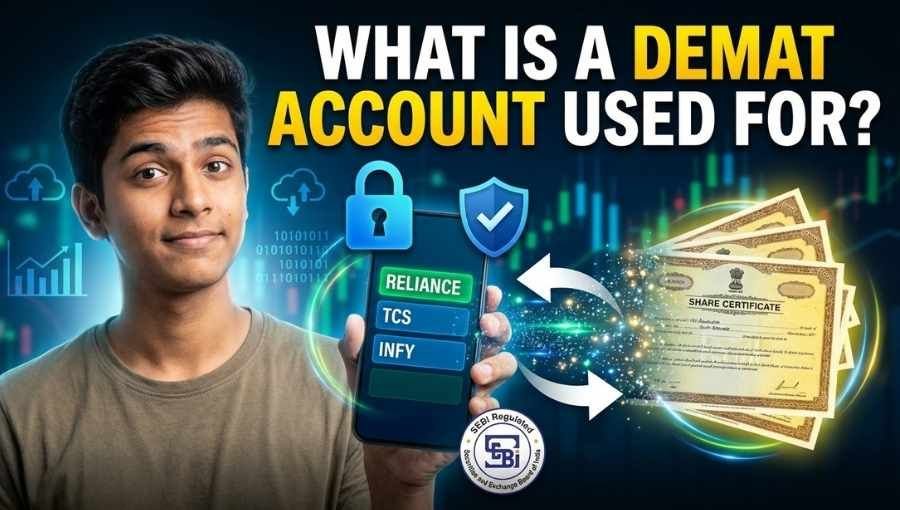
Earlier, shares were issued as physical paper certificates. Today, in India, all shares exist only in electronic form. A Demat account is used to hold these digital securities safely.
What Is the Use of a Demat Account?
A Demat account is mainly used for the following purposes:
- Holding shares in electronic form
- Buying and selling shares in the stock market
- Receiving bonus shares and rights issues
- Storing other investments like mutual funds, ETFs, and bonds
- Maintaining safe and paperless ownership records
As per current regulations in India, it is not possible to invest directly in shares without a Demat account.
Why Is a Demat Account Mandatory in India?
India has shifted to a fully electronic investing system to make the market:
- Safer
- Faster
- More transparent
Because of this:
- Physical share certificates are no longer used
- All trades on stock exchanges are settled electronically
This system helps reduce fraud, delays, and paperwork, while improving overall efficiency.
How Does a Demat Account Work? (Step-by-Step)
Step 1: Placing a Buy Order
You place a buy order using a trading account, which is linked to your Demat account.
Step 2: Order Execution
The order is executed on stock exchanges like the National Stock Exchange (NSE) or the Bombay Stock Exchange (BSE).
Step 3: Settlement and Credit
After settlement (usually T+1 working day):
- Shares are credited to your Demat account
- Money is debited from your bank account
At this point, you officially become the owner of those shares.
Demat Account vs Trading Account
Understanding the difference between these two accounts is important for beginners.
| Feature | Demat Account | Trading Account |
|---|---|---|
| Purpose | Stores shares and securities | Used to buy and sell shares |
| Function | Acts like a digital locker | Acts as a transaction platform |
| Role | Shows ownership of assets | Executes market orders |
| Usage | Long-term holding | Active transactions |
Both accounts are required for investing, but they perform different functions.
What Can Be Stored in a Demat Account?
A single Demat account can hold multiple types of investments, such as:
- Equity shares
- Mutual funds
- ETFs (Exchange-Traded Funds)
- Bonds and debentures
- Government securities
This allows you to manage and track all your investments in one place.
Who Regulates Demat Accounts in India?
Demat accounts in India are regulated by Securities and Exchange Board of India.
They are maintained through authorized depositories like:
- NSDL
- CDSL
SEBI ensures:
- Investor protection
- Transparent records
- Fair market practices
However, it is important to understand that SEBI does not guarantee profits or protect against market losses.
Common Misunderstandings Beginners Have
Many beginners have incorrect assumptions about Demat accounts, such as:
- Thinking a Demat account itself generates profit
- Believing it works exactly like a bank account
- Assuming daily trading is required after opening it
- Considering it risky on its own
The reality is simple:
The risk comes from investments, not from the Demat account itself. The account is just a storage system.
Is Minimum Balance or Investment Required?
In most cases:
- There is no strict minimum balance requirement
- You can open an account and start investing later
- Charges may vary depending on the broker
It is always a good idea to check the fee structure before opening an account.
Clear Takeaway
A Demat account is the foundation of investing in the Indian stock market. It does not generate profits on its own, but it enables safe, transparent, and paperless investing.
For beginners, the first step should be to clearly understand what a Demat account does and what it does not do. Once that clarity is in place, making better investment decisions becomes much easier.
FAQs
Can I buy shares without a Demat account?
No, a Demat account is mandatory for direct share investment in India.
Is a Demat account safe?
Yes, it operates under a regulated electronic system.
Can one person have multiple Demat accounts?
Yes, but most investors prefer to keep one for simplicity.
Does a Demat account expire?
No, it remains active as long as it is maintained.
Disclaimer: The information provided on Finance Tadka is for educational and informational purposes only and should not be construed as financial, investment, or trading advice. We are not SEBI-registered investment advisors. The content published on this website is not a recommendation to buy, sell, or hold any securities or financial instruments.।